Everything You Need to Know About Flood Risk Assessments
The Flood Risk Assessment may be necessary to assist with planning applications for any development project involving flood risk. Having an effective Flood Risk Assessment will ensure that all flood risk issues are appropriately managed and recognized within the context of any planning authority. As an expert Flood Risk Assessment consultancy in the UK, we provide Flood Risk Assessment planning services across England. We also undertake Flood Risk Assessments for due diligence, property transactions and other purposes. So, speak to Flood Risk and Drainage Solutions consultants to discuss your site and obtain a fixed-fee quote.
Analyzing what a Flood Risk Assessment Is
Flood Risk Assessment (FRA) refers to a detailed document that evaluates the probability and severity of flooding within and around a property. Additionally, the document outlines how a particular development project may be designed and managed to ensure safety and eliminate flood risk to nearby areas.
A Flood Risk Assessment document is generally needed when making planning applications and in many other cases, such as land purchases and financial transactions, where flooding may pose potential risks.
How to Interpret Flood Zones for Development Projects
It is important to understand flood zones to evaluate risk during development. One can check whether they fall within a flood zone using mapping techniques provided by the authorities.
- Flood Zone 1: The risk of flooding is relatively low. It is considered to pose little threat to development, as its annual risk of river or sea flooding is below 0.1%. Nevertheless, it might require further investigation regarding the risks posed by surface water and drainage.
- Flood Zone 2: The risk of flooding in this area is considered to be moderate and poses an annual risk of flood from rivers at 0.1% to 1%, and from the sea at 0.1% to 0.5%. Developments in this zone are permitted provided a Flood Risk Assessment is carried out before construction.
- Flood Zone 3: The risk of flooding in this zone is high, with annual flood risk from rivers exceeding 1% and from the sea exceeding 0.5%. Development in this zone is restricted due to flooding risks. However, these flood zones can be identified using the Environment Agency Flood Map for Planning.
What Is Included in a Flood Risk Assessment?
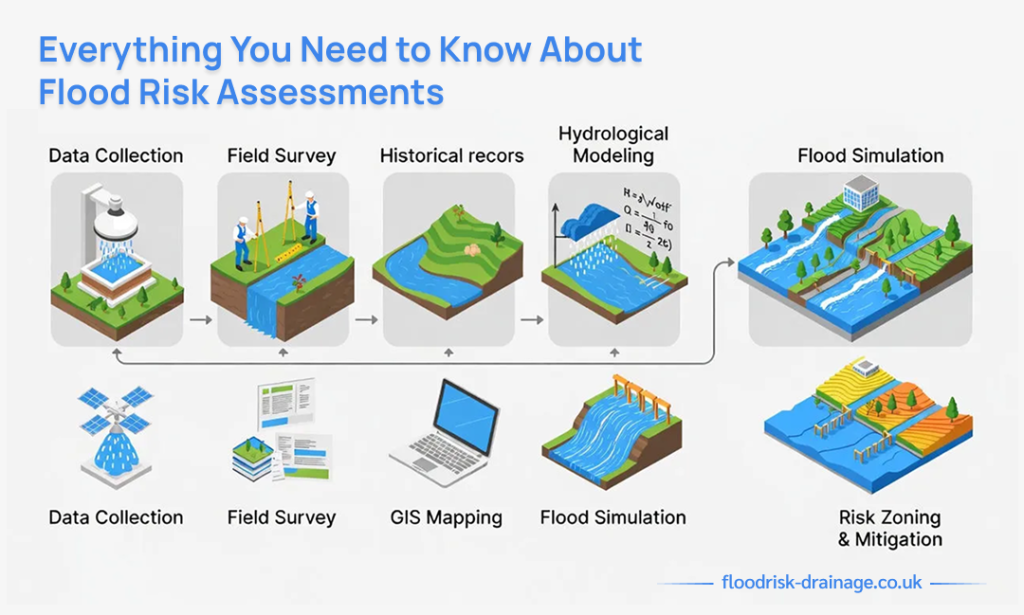
The scope of a Flood Risk Assessment (FRA) depends on various factors related to the location and proposed development, and usually includes data review, technical assessment, and report writing.
Data Review and Flood Risk Analysis
At the early stages of an FRA, data sources, such as flood maps and flood history, as well as local data, may be reviewed. Sources of flood risk may include rivers, surface water, groundwater, or the coast.
Flood Modeling and Hydraulics
Hydraulic modeling may be conducted where appropriate to further understand the flow dynamics of flooding on site. This is particularly relevant for more complicated developments or sites where there may be an increased risk of flooding.
Site Assessment
A site assessment considers factors such as the site’s topography, existing drainage system and development plans. It provides supporting evidence for planning applications and helps decision-makers understand that flood risks have been properly addressed.
Flood Risk Management Strategy and Drainage Issues
An FRA details the strategies for managing and mitigating flood risks. These can encompass advice on the height of completed floors, safe access and egress routes, site reconfiguration, and good drainage systems for surface water.
Flood Risk Assessment Report Production
The last step is to develop a comprehensive report. This document illustrates adherence to the planning policy and highlights the assessment and management of the flood risks.
Wider Uses of Flood Risk Assessment Reports
In addition to planning applications, Flood Risk Assessments can be used for property sales, insurance, loans, business due diligence, and even BREEAM certifications. The flood risks identified by these assessments help parties make informed decisions.
For Buying and Selling of Properties
Flood Risk Assessments are usually conducted when buying property and undertaking conveyancing. They ensure that a thorough analysis is conducted to assess the flood risks present within the property. This will ensure that all parties involved in the purchase know how to mitigate the risks and address insurance issues. It also helps identify any required mitigation measures, insurance considerations, or planning constraints.
For Insurance and Mortgage Applications
Sometimes, when applying for mortgages and insurance, one needs to conduct a Flood Risk Assessment. Moreover, this process helps assess the property’s flood risk, so lenders can determine whether to approve the loan. It will also help determine the insurance premiums payable. With a comprehensive Flood Risk Assessment, obtaining approvals is easy, and there is no risk, as it ensures that appropriate measures to mitigate flood risks are in place.
For Business Risks and Due Diligence
A Flood Risk Assessment is commonly used in business operations, particularly during due diligence, to assess the risks of potential flooding. It is designed to determine the flood risk for any particular site, property, or portfolio, to inform investment decision-making, property management, and other business continuity strategies in flood-prone areas. It also plays a key role in business continuity planning by identifying vulnerabilities and recommending mitigation measures.
For BREEAM Certification
A BREEAM Flood Risk Assessment is usually an integral component of achieving BREEAM certification, in which flood risk and resilience are critical considerations that lead to sustainability credits. It then identifies appropriate mitigation measures such as finished floor levels, drainage strategies, and resilient design approaches. In this assessment, the flood risks of a specific site are analyzed, followed by the formulation of strategies to address them and ensure certification.
Why choose Flood Risk and Drainage Solutions for Assessments
At Flood Risk & Drainage Solutions, our team offers more than 10 years of professional industry experience, assisting clients in securing successful planning applications and site-specific Flood Risk Assessments and Drainage Designs.
All our assessments comply with NPPF guidelines and are carried out in accordance with the Environment Agency and the Local Planning Authorities’ guidelines. In contrast to other firms that offer unrealistic delivery time frames, general assessments, and false pass rates, we aim to be as open and honest about our work as possible.
Our team comprises qualified consultants and is part of the Chartered Institution of Water and Environmental Management (CIWEM). We comprise Chartered Members (MCIWEM C.WEM), Members (MCIWEM), and Graduate Members (GradCIWEM). It demonstrates our commitment to high professional standards and best practice in flood risk and environmental management, in line with CIWEM’s role in the sector.
Final Words
Overall, flood risk assessment is an important activity that extends well beyond the planning process, providing critical information on property transfer, financial planning, business risk management, and sustainability accreditation. Flood Risk & Drainage Solutions offers accurate, evidence-based evaluations to determine flood risks and develop appropriate risk management plans in accordance with applicable standards. By offering high-quality flood risk reports, Flood Risk & Drainage Solutions helps individuals make sound, responsible decisions about their future investments.