-
Pingback: Future Trends Shaping Modern Drainage Design Layout Practices | Flood Risk & Drainage Solutions
-
Pingback: Planning Appeals 2026 Flood Risk & Drainage Design Changes
Step-by-Step Process to Create Underground Drainage Layouts
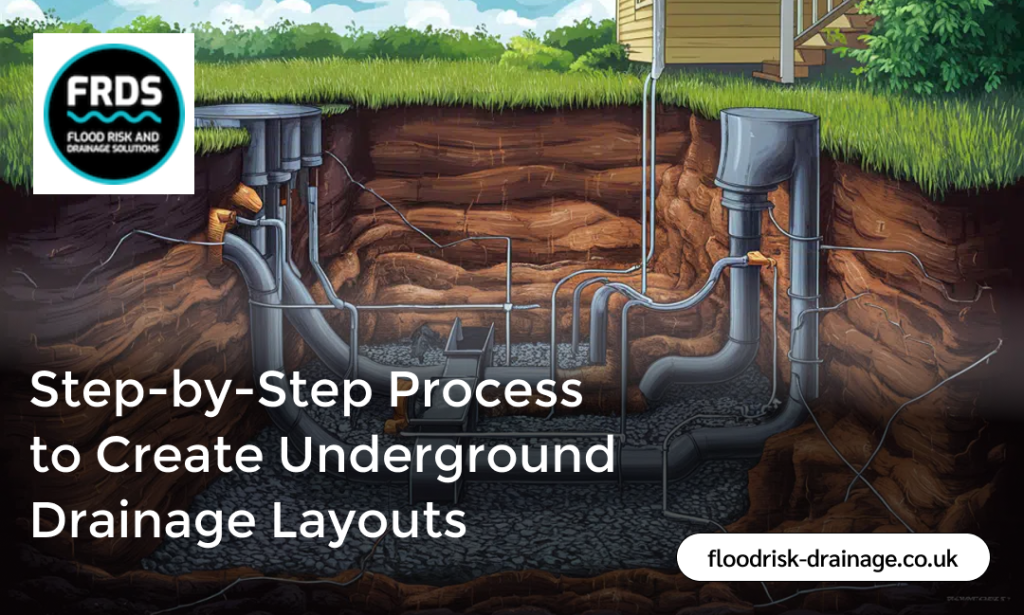
Proper planning of underground drainage layouts is essential for residential and commercial buildings. This helps properly manage water, ensuring it does not cause flooding or damage to buildings. The use of SUDS drainage systems, such as permeable surfaces and retention ponds, also helps better manage rainfall to ensuring it does not damage the environment. Thus, a proper understanding of these concepts at an early stage of underground drainage layout design helps create better, more durable underground drainage layouts.
Stepwise Planning and Execution of Underground Drainage Layouts
Designing an efficient underground drainage system is necessary for the effective management of water in residential and commercial buildings. The incorporation of SUDS drainage systems is necessary for the effective management of water runoff.
Conduct a Comprehensive Site Survey
Before designing underground drainage schemes, it is important to carry out a site survey. Site assessment involves evaluating the topography, soil type and natural flow of water. Moreover, accurately measuring and mapping the site with the help of good drainage planning will allow one to pinpoint potential areas of concern. Site assessment is important because it enables one to design a drainage system that meets the site’s unique needs, thereby preventing waterlogging and damage.
Assess and Define Water Management Needs
By using SUDS drainage systems such as soakaways, ponds and permeable pavements, stormwater management is enhanced sustainably. Seasonal changes should also be considered, along with potential surface runoff in residential or business areas. Accurate assessment is crucial to ensure that the stormwater management system can handle the loads without overburdening the local drainage systems. Proper planning for the drainage requirements is essential to ensure efficiency and provide eco-friendly solutions with long-lasting benefits for the area.
Create a Detailed Drainage Design Plan
A drainage layout plan should be prepared, showing the path of water flow, the route of the drainage pipes, the locations of manholes, inspection points, and the gradient of the slopes. This ensures a smooth flow of water, prevents backflow, and makes future maintenance easier. An efficient drainage planning eliminates costly construction errors, making it easier to comply with local building codes. A detailed plan also makes the implementation of surface water management strategies efficient.
Develop an Effective House Drainage Strategy
In residential buildings, it is important to have a house drainage plan to protect both the building and the environment. It should be connected to different areas, such as rooftops, bathrooms, kitchens, and other areas. This will prevent water from accumulating, causing damage and land erosion. Thus, it is also important to connect it to landscaping to ensure it is both aesthetically pleasing and functional. This will ensure it protects the environment and also supports sustainability.
Select Durable Materials and Proper Equipment
Selection of appropriate materials for the pipes, fittings, and valves used in the drainage system is a key factor in planning the drainage system. Suitable materials for the house drainage layout plan could include PVC, HDPE, or concrete, depending on site conditions, water type, and load. Suitable tools and equipment are necessary for excavation, pipe laying, and connection installation, which should be of good quality to achieve long-term best results. Thus, ensuring that the drainage system works efficiently with minimal maintenance for a long time.
Execute Installation and Plan Maintenance
Excavate trenches and lay pipes according to the detailed design only, ensuring slopes are good for the efficient flow. Water flow should be tested for more leaks or blockages and adjustments made as important. Regular inspections and maintenance are very important for maintaining the system’s long-term efficiency. A well-installed system ensures efficient underground drainage layouts, thereby safeguarding the structures from damage. So, a plan should be made to clean and inspect SUDS drainage components and to monitor the system’s performance.
Cost-Effective Solutions for Underground Drainage Layouts
Implementation of an efficient underground drainage system is very important for the effective management of water within residential and commercial properties. By incorporating the use of SUDS drainage systems, the long-term protection and cost-effectiveness can be ensured.
Design Efficient Underground Drainage Layouts
An efficient underground drainage system manages water effectively while reducing long-term maintenance costs. A well-designed underground drainage system can prevent cases of flooding and protect foundations from water damage.
Integrate SUDS Drainage Techniques
SUDS drainage techniques, including soakaways, retention ponds and permeable pavements, can be integrated to manage stormwater runoff in a sustainable manner. These techniques are environmentally friendly and cost-effective alternatives to conventional stormwater drainage systems.
Prepare a Detailed Drainage Layout Plan
Developing a detailed drainage layout plan before installation helps avoid mistakes during construction. Moreover, it ensures proper pipe routing, slopes and inspection points, all of which are critical to proper water flow.
Plan a House Drainage Layout Plan
For residential homes, an effective house drainage layout is essential to ensure that all water sources, such as rooftops and bathrooms, are properly drained. This will help prevent waterlogging, which could result in costly repairs in the future.
Focus on Drainage Planning and Professional Guidance
Drainage planning, along with professional guidance, is essential to ensure the installation of systems and compliance with local regulations. It also extends system longevity, thereby providing maximum savings.
Incorporate Future Expansion Considerations
When designing your drainage system, ensure there is room for expansion in the near future. Flexibility in the house drainage layout plan will ensure that additional structures can be added without having to reconstruct the system.
Final Words
To sum up, an appropriate design for a house drainage layout plan has numerous advantages, including reduced flooding risk, lower maintenance costs, and increased property durability. It is essential to ensure that water drains properly for the proper maintenance of residential and commercial properties, which is only possible through appropriate drainage planning. It is advisable, especially for complex drainage systems, to consult a professional for an appropriate design that ensures an efficient house drainage layout for years to come.